
|


|
|
|
|
| contents: |
Summary: A key aspect of avoiding accidents is to "be predictable": to make it easy for motorists and other cyclists to tell what you are going to do. Mostly, this involves simply following the same rules as other vehicles, but there are some fine points about where to ride on the roadway, how to change lanes safely, and how to handle intersections.
"Vehicular cycling" refers to the practice riding a bicycle in a way similar to the way drivers handle motor vehicles. Typically you will follow the same path as a motor vehicle, although you will frequently be displaced a bit to the right so as not to hold up faster traffic. This approach tends to minimize the amount of sideways motion on the roadway. Similarly turns are made the same way that drivers make turns. The rationale is based on the observation that stopping distances and turning radii increase quadratically with speed, and consequently a cyclist, who is almost always riding at well above the speed of a pedestrian, should behave more like the driver of a vehicle than like a pedestrian. The following practices are advisable.
An appropriate position on the roadway is shown in the next figure. The figure shows several lane widths, but the width of each section and the distances between vehicles have been shortened.

In this figure,
It is particularly important the cyclists stay as far from the curb as possible without unduly interfering with faster traffic. While staying as far as possible from overtaking vehicular traffic may seem safer, accident statistics show that being hit from behind is an unlikely accident, accounting about 10 percent of all bicycle accidents in which the bicycle is hit by a vehicle, and of this 10 percent, over half result from a cyclist swerving in front of a car. As a result, riding in a straight line is more important than staying as far away from vehicles as possible. As will be shown in the next section, staying away from the curb provides room for turning and can allow a cyclist to avoid swerving in the path of an overtaking vehicle when it is necessary to avoid an obstruction.
The number of lane changes a cyclist makes should be minimized, as unnecessary lane changes increase the risk of an accident.
Changing lanes should be done carefully and slowly, waiting until it is safe, and moving sideways on the roadway slowly enough so that there is plenty of time to react if there is a miscommunication about intentions. The procedure requires three stages:
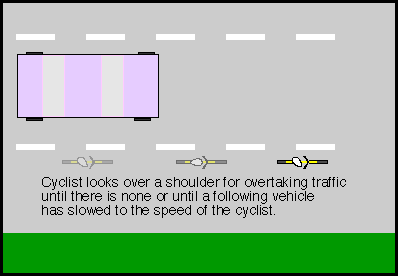
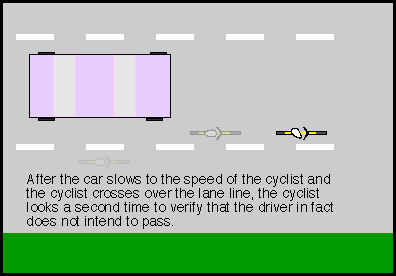

The following describes some of the points relevant specifically to cyclists. For a general overview of how to make vehicular turns, please see the relevant section of the Driver's Handbook provided by the California Department of Motor Vehicles.
The rule for handling intersections safely is to choose a path through the intersection (as allowed by traffic laws) so as to minimize the number of lane changes. In the typical intersection, this means that

For the case where there is a lane that can be used by turning and "through" traffic, the positions are illustrated in the next diagram.

A cyclist should ideally be in a position in the lane so that drivers will not cut the cyclist off by turning across the cyclist's path. When stopped (at a stop sign or red light), the best position is the center of the lane. Then if a car that is about to turn shows up, you can move the bicycle to the side to let the car by.
For U-turns, use the rightmost lane from which a U-turn is permitted. If a car can make a legal left turn from a lane to the left of the lane the cyclist is in, the cyclist is not far enough to the left.
While, as stated above, you should use a full traffic lane when the lane is too narrow to share with a motor vehicle, you should also ride in the stream of traffic when going as fast as motor vehicles. Otherwise, you should ride parallel to the stream of traffic, just far enough to the right to allow overtaking traffic to pass easily. The following figure shows why.

To summarize,
The use of lights and reflectors at night is legally required, but more importantly, the use of lights and reflectors is necessary for safety. Any light that can be purchased for use as a bicycle light is adequate, although the more expensive ones (the high-wattage ones) are useful for some purposes. If a cyclist rides at high-speeds on steep, unlit, windy roads in the dark, a state-of-the-art lighting system will be worth the purchase price. If, on the other hand, a cyclist rides at more modest speeds on city or suburban streets, a low-cost light is adequate.
While it might seem that an automobile's headlights are adequate for seeing cyclists if reflectors are used, in fact, an approaching cyclist may not appear in the headlight's beam until the last second, as can be seen in the following figure.

While a rear light is not legally required, it is well worth having: as of the time this track was written (1999), there seems to have been a significant increase in incidents of drivers wandering around at night with their headlights turned off, and reflectors are completely ineffective when drivers don't turn on their lights.
 |
|