
|
|
Bicycling Safety for Drivers
| |
|
|


|
|
3 Being Predictable
Summary:
The parallel track for cyclists encourage cyclists to "be predictable":
to follow normal traffic laws. The following provides an overview
of how motorists can expect cyclist (at least, experts) to behave. It
is worth remembering, though, that novices, especially children, can be
unpredictable, and additional care is warranted.
For a bicycle speed of 15 mph, at 0.57g you can stop in 13.1 feet and your
turning radius is 26.2 feet (corresponding to leaning the bicycle 30 degrees from
vertical). Such stopping distances and turning radii are typical of cyclists with
a high skill level, and both values can be even larger for less skilled cyclists.
In any event, both of these values are large enough that a cyclist has to behave
like the driver of a slow vehicle rather than like a pedestrian. Expert cyclists
will typically
- obey normal traffic rules.
- ride in a straight line (i.e., parallel to the lane lanes), changing position
on the roadway slowly and carefully.
- nominally stay 3 to 5 feet to the side of vehicular traffic
(i.e., with a 3 to 5 foot gap between the cyclist and vehicular traffic),
but if the lane width is not sufficient, cyclists will use the full
traffic lane. In this case, a lane change is necessary for a vehicle to
pass. Cyclists will also use a full traffic lane when riding as fast as
other traffic to avoid being "lost" in a vehicle's blind spot.
Less experienced cyclists, and particularly children, may behave erratically.
Cyclists will position themselves on the roadway so as to minimize the risk of
an accident. Accidents in which a cyclist is hit from behind occur infrequently,
and most accidents (and for that matter, most fatalities) involve conditions
that occur ahead of the cyclist. It is particularly dangerous to be constrained
with no room for maneuvering.
An appropriate position on the roadway is shown in the next figure. The figure
shows several lane widths, but the width of each section and the distances between
vehicles have been shortened.
In this figure,
- Bike 1 is in an appropriate position, with ample clearance from motor
vehicles, and with amble clearance from the curb.
- Bike 2 has left enough room so that vehicles will try to "squeak"
by, passing dangerously closely on one side while right next to the curb
on the other.
- Bike 3 has used the full lane (in this case, because the lane is so narrow
that passing is not possible no matter where Bike 3 goes). While the car
should follow with more of a gap than shown in the figure, as long as the car
is moving at the same speed as the bicycle, there is no risk to the cyclist:
the driver knows the cyclist is there and will pass when safe by crossing at
least partially into the next lane.
Bike 2 would be safer by following the path used by Bike 3, even though this would
put Bike 2 in the path of traffic (merging into traffic, of course, has to be done
carefully). Expert cyclists will typically follow the path shown for Bike 3 if
the lane is too narrow to be safely shared. Except for some rural roads that
typically have little traffic, the most frequent case in which cyclists have to
use a full lane occur near intersections, where additional turn lanes have been
squeezed in to improve the level of service at the intersection. Such narrow
sections are typically short.
In order to avoid miscommunication of intentions with drivers, experienced cyclists
will change lanes as follows, and drivers should be aware of this practice:
- The cyclist should first look over a shoulder to see if there are
overtaking vehicles.
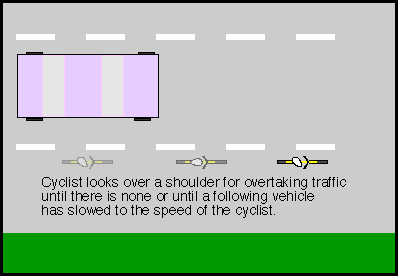
In some conditions (particularly
near reflector dots or when it is necessary to brake), a cyclist may not be
able to give a normal hand signal. If a cyclist looks alternately over his/her
shoulder or straight ahead, drivers should interpret that as a signal.
The cyclist will probably take some concrete indication from the driver, such
as slowing to the cyclist's speed, as an indication that the driver will
"let" the cyclist into the lane.
- Once the cyclist has determined that a lane change is safe, the cyclist
can cross the lane stripe. The cyclist may check again by looking over
a shoulder before preceeding across the lane.
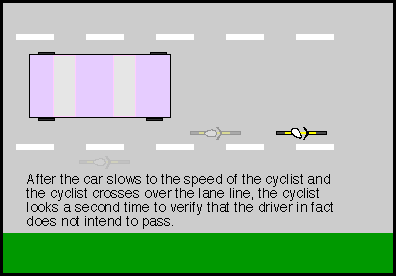
Note that it takes a few seconds for each phase,
and you should allow at least 5 seconds to get the attention of an overtaking driver.
At 15 mph (22 feet per second), a cyclist will have to leave couple of hundred feet as the
bare minimum distance needed to cross a traffic lane.
Expert cyclists will typically choose a path through an
intersection (as allowed by traffic laws) so as to minimize the number of
lane changes. In the typical intersection, this means that
- right-turning bicycles will typically be on the right side of the right lane.
- bicycles proceeding straight will typically be in the lane furthest to the right
from which continuing straight is permitted. The appropriate
position in the lane depends on whether a right turn is permitted
from this lane:
- if no right turns are permitted, the cyclist will typically be near
the right edge of the lane.
- if right turns are permitted, the cyclist will typically stay far
enough to the left to discourage right-turning drivers from
cutting the cyclist off.
- left-turning bicycles will typically be in the rightmost lane from which a
left turn is permitted. In this case,
- if the lane is a left-turn-only lane, the cyclist will typically be at
its right edge.
- if the lane allows both left-turning and "through" traffic,
then the cyclist will typically stay far enough right to discourage
a left-turning car from turning in front of the cyclist.
For turn lanes that are left-turn or right-turn only, the positions are illustrated
in the following diagram.

For the case where there is a lane that can be used by turning and "through"
traffic, the positions are illustrated in the next diagram.
A cyclist will ideally be in a position in the lane so that drivers will not cut
the cyclist off by turning across the cyclist's path. When stopped (at a stop
sign or red light), expert cyclists will often wait in the center of the lane.
Then if a car that is about to turn shows up, you can move the bicycle to the
side to let the car by. Cyclists who do this will look over their shoulders to
check the turn signal, so it is important to use the turn signals even though the
cyclist is ahead. Once the cyclist can proceed, the cyclist will move to the
normal position on the roadway.
While, as stated above, a cyclist may use a full traffic lane when the lane is
too narrow to share with a motor vehicle, a cyclist may also ride in the stream
of traffic when going as fast as motor vehicles. The following figure shows why
This is necessary.
Note how the cyclist is in a position where the vehicle ahead cannot cut the
cyclist off by turning. Drivers should expect to see cyclists riding in this
way.


